

Understand What It Does in 30 Seconds
Before installation vs. after installation:
In one sentence: your coding agent goes from “only able to write code” to “also able to generate images, generate videos, generate music, and search the web.”
Get Started in Three Steps
The entire process can be completed in a few minutes and requires Node.js 18+. Step 1 · Get an API Token. Go to the console and copy a Token—this single one is shared by all capabilities. Your first application comes with free credits, so you can try it for free first.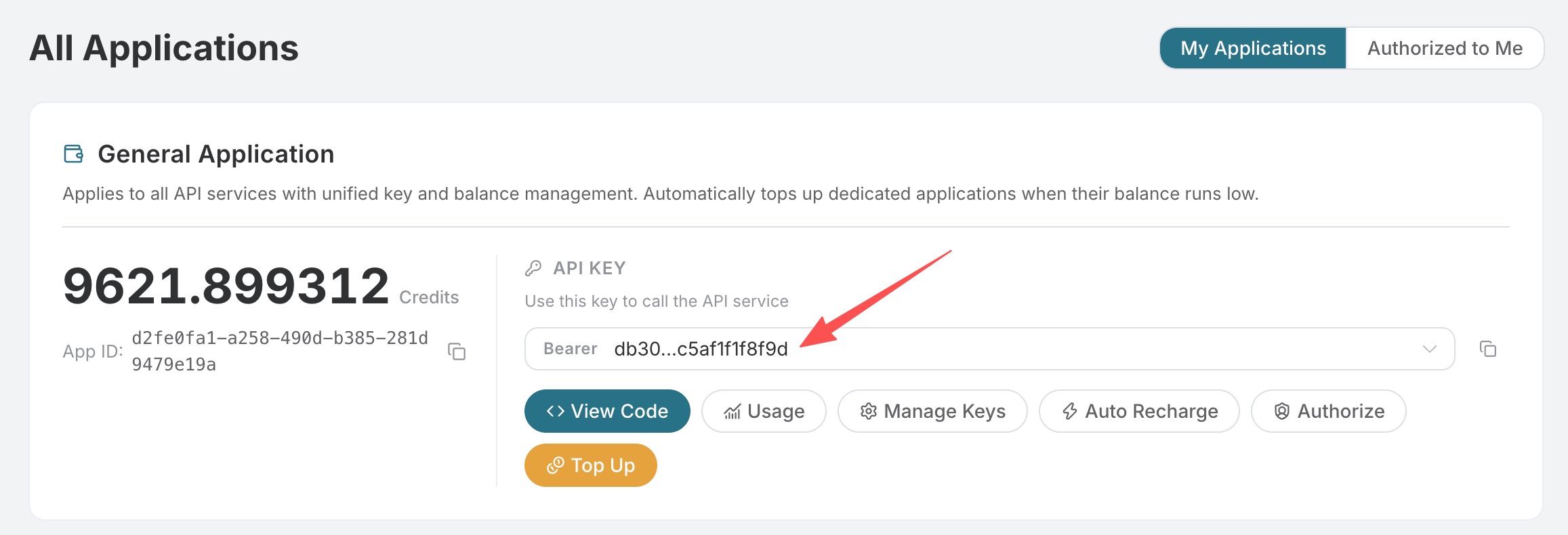 Step 2 · Install. One command:
If no Token is set, the first run will interactively prompt you to paste one; you can also runStep 3 · Speak naturally. Reload your agent, then directly give it instructions, for example:export ACEDATACLOUD_API_TOKEN=yourtokenin advance for a completely unattended installation. The number of skills will change as platform capabilities increase; refer to the current list displayed bynpx acekit list.
Run It for Real (With Output)
The following four examples are all real calls with results returned on the spot, not demonstrations. The$KEY in the commands is your API Token.
① Shorten a URL (synchronous, returns in seconds)
https://surl.id/r/1uKp2kilXQ—opening it will redirect with 302 back to the original services page.
② Web search (synchronous)
 You do not actually need to remember these APIs—after installing the skills, the agent will assemble the correct requests itself according to each
 SKILL.md, and handle authentication and polling. The above only lays out for you “what it does behind the scenes.”
What Exactly Does It Install
AceKit is the “front door” to AceData’s entire developer tool surface. At present, a single installation installs the skill toolkit (Skills):- A set of Agent skills: each skill is a pre-written
SKILL.mdoperation manual—authentication, asynchronous polling, error retries, and how to fill in parameters are all clearly documented; the agent only needs to follow it. Runnpx acekit listto see the current list (there are 19 at the time of writing, and it continues to grow):
- One unified Token: One
ACEDATACLOUD_API_TOKENunlocks all capabilities, billed based on actual usage.
npx acekit list):
For these same capabilities, AceData also provides standalone MCP servers (Suno, Midjourney, Sora, SERP… published to PyPI / VS Code / Smithery / Docker), command-line CLI, and Python / TypeScript SDK, which can be used separately as needed. AceKit v0.2 plans to support single-capability installation via acekit add <name>, as well as automatically writing MCP configurations for each agent.
Which Agents Are Supported
During installation, AceKit automatically detects the agents installed on the machine and installs only into the detected ones.
Easter Egg: Use the Same Token to Power Claude Code Itself
AceData’s interface is also compatible with Anthropic’s/v1/messages format, so you do not need an official Anthropic subscription. You can use the same AceData Token to power Claude Code. Create .claude/settings.local.json in the project root directory:
Start for Free
AceKit is open source (MIT), with the repository at github.com/AceDataCloud/AceKit. If you find it useful, please give it a ⭐.- 🔑 Free API Key & Documentation: https://platform.acedata.cloud
- 💬 Discord: https://discord.gg/f9GRuKCmRc
- 🐦 X: @acedatacloud
- 📧 Email: office@acedata.cloud