

prompt (optionally attaching reference images/videos/audios with file_urls), and a headless “AI director” will automatically complete the topic selection, script writing, scene generation, voiceover, music, synthesis, and rendering, ultimately producing a subtitled final product and uploading it to the CDN.
This article will provide detailed instructions for integrating the Maestro video generation API, helping you quickly integrate and fully utilize the capabilities of this API.
This is an asynchronous task interface: after submission, it will immediately return a task_id, and you can then poll for results through the Maestro Task Query API (POST /maestro/tasks) (polling is free of charge). To continue iterating on an existing video, you can use action: remix / edit / extend along with ref_task_id.
Application Process
To use the Maestro video generation API, first go to the Ace Data Cloud Console to obtain your API Token for future use.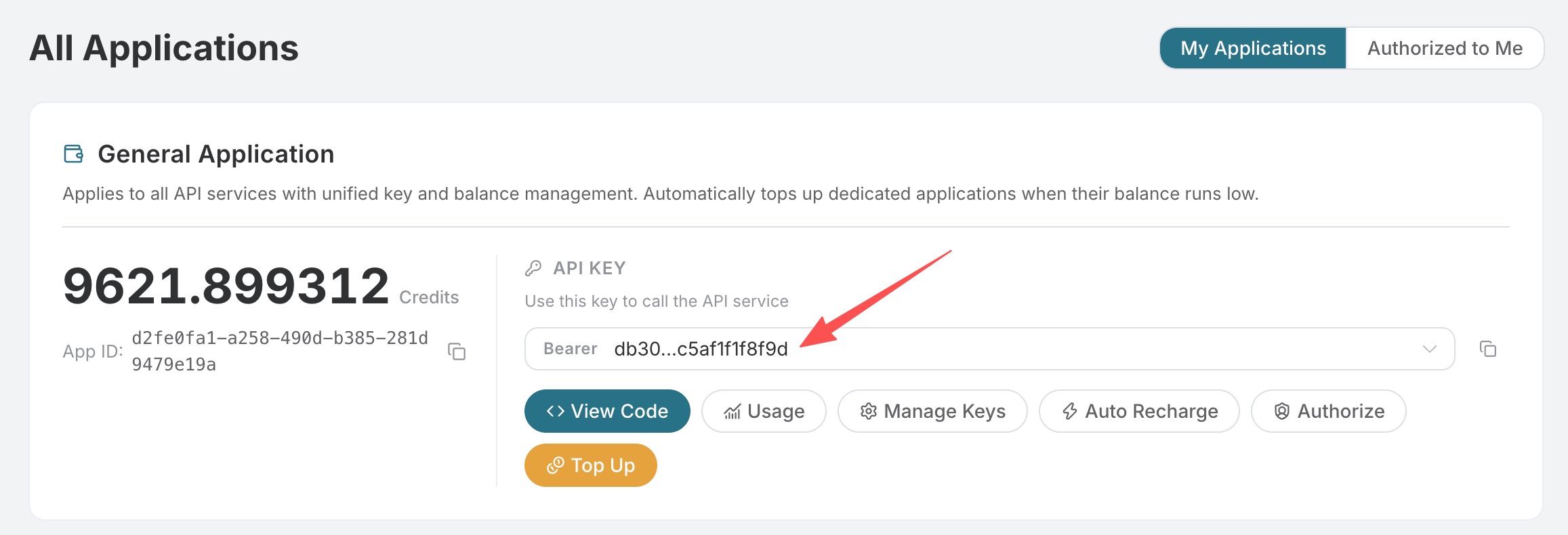 If you are not logged in or registered, you will be automatically redirected to the login page to invite you to register and log in, and after completion, you will be automatically returned to the current page.
One API Token can call all services on the platform, without needing to apply separately for each service. The first application will grant a free quota for you to experience it for free; when the quota is insufficient, you can recharge the general balance in the console.
If you are not logged in or registered, you will be automatically redirected to the login page to invite you to register and log in, and after completion, you will be automatically returned to the current page.
One API Token can call all services on the platform, without needing to apply separately for each service. The first application will grant a free quota for you to experience it for free; when the quota is insufficient, you can recharge the general balance in the console.
📘 Complete Documentation: Maestro Video Generation API →
Basic Usage
POST https://api.acedata.cloud/maestro/videos
The most basic usage requires only passing in a natural language prompt, and the AI director will automatically decide the script, scenes, voiceover, and editing. Here we will first understand the request headers and request body that need to be set.
Request Headers include:
accept: the format of the response result you want to receive, here it is filled in asapplication/json, which means JSON format.authorization: the key to call the API, which can be directly selected after application.content-type: the format of the request body, here it is filled in asapplication/json.
prompt: a natural language description of the video to be made (theme, what to showcase, style, audience).langs: an array of output languages, such as["zh-cn", "en"], default is["zh-cn"].aspect: aspect ratio,9:16(default) /16:9/1:1.duration: target duration (seconds), default is 30.
Below is a specific example to demonstrate. Suppose we want to generate a bilingual (Chinese and English), vertical, 20-second science popularization short video, the corresponding CURL code is as follows:
success: Whether the task was successfully submitted.task_id: The ID of the video generation task, which will be used to poll for results via the Maestro Task Query API.trace_id: The tracking ID of this request, which can be provided to technical support for troubleshooting.
task_id and will not wait for the video rendering to complete. You will need to use task_id to poll for results, as detailed in the “Get Results” section.
Specify Video Type and Style (scenario / style)
Ifscenario is not provided, AI will automatically determine it (equivalent to auto); if you want to pin the video to a specific type, you should specify it explicitly. For example, to create a vertical short drama, you can specify the following content:
scenario: Video type, set todrama(a short drama with characters + dialogue).style: Visual style, set tocinematic(film quality).
- Narrated short video:
scenario: "narrated", supported by Lite / Standard / Pro. - Automatic subtitles:
scenario: "captions", requiresfile_urlsto pass the source video, supported by Lite / Standard / Pro. - Digital human / voiceover:
scenario: "avatar", requiresfile_urlsto pass a portrait, supported by Standard / Pro. - Short drama:
scenario: "drama"(characters + dialogue), supported only by Pro. styleis a preset visual style (e.g.,modern/neon/luxury), which does not change the type but only affects the visual experience.voiceis used to specify the tone of the narration (e.g.,warm-female/deep-male), independent of language and applicable across languages.
task_id.
Multilingual Output
By passing multiple languages inlangs, you can produce multilingual versions at once. The first is the primary language, and each additional language will reuse the same set of visuals, only adding voiceover + rendering, so each additional language only adds +6 points. Example:
variant in the results (see Maestro Task Query API).
Iterate on Existing Videos (remix / edit / extend)
By passingaction and the previous task’s ref_task_id, you can make incremental modifications based on the original project (e.g., “change the title of Act 2,” “change the voiceover,” “darken the overall tone”). Small changes are quick, while large changes will be redone:
remix: Reinterpret the original video structure (retain the theme, adjust the presentation).edit: Refine specific parts (e.g., change title, change voiceover, adjust color).extend: Expand content based on the original video.
task_id, which you can use to poll for the final product after iteration.
Get Results
Since video production takes a long time, this interface will immediately returntask_id after submission, and you need to use it to poll for results via the Maestro Task Query API:
variant). The status will go through pending → planning → producing → succeeded (or failed), polling is free and does not consume points. For the complete response format and historical list query, please refer to the Maestro Task Query API Integration Guide.
Billing
Billing is based on the actual completed product after the task is finished, and failed tasks are not charged. Billing is based on the actual delivered product duration and the number of languages, and the billed duration will not exceed the requested duration. If a certain language does not produce a final output, the +6 surcharge for that language will not be charged. Submitting the task itself is not charged separately, and/maestro/tasks polling is free.
The points for a single completed product are calculated as follows:
drama 1.35× / avatar 1.15× / others 1×.
Error Handling
When calling the API, if an error occurs, the API will return the corresponding error code and message. For example:400 invalid_request: Bad request, possibly due to a missingpromptor invalid parameters.401 invalid_token: Unauthorized, invalid or missing authorization token.403 forbidden: Forbidden, insufficient balance or access.429 too_many_requests: Too many requests, you have exceeded the rate limit.500 api_error: Internal server error, something went wrong on the server.
Error Response Example
Conclusion
Through this document, you have learned how to use the Maestro video generation API: with just a natural languageprompt, you can automatically complete scripts, materials, voiceovers, music, editing, subtitles, and rendering, and it supports specifying video types, styles, tones, multilingual output, and iterating on existing videos. We hope this document helps you better connect and use the API. If you have any questions, please feel free to contact our technical support team.
Related Interfaces
- Maestro Task Query API Integration Instructions: Use the
task_idreturned byPOST /maestro/videosto query the task status and results, or to pull the history of task lists (polling is free).