

Application Process
To use the Nano Banana Images API, first go to the Ace Data Cloud Console to obtain your API Token and keep it for later use.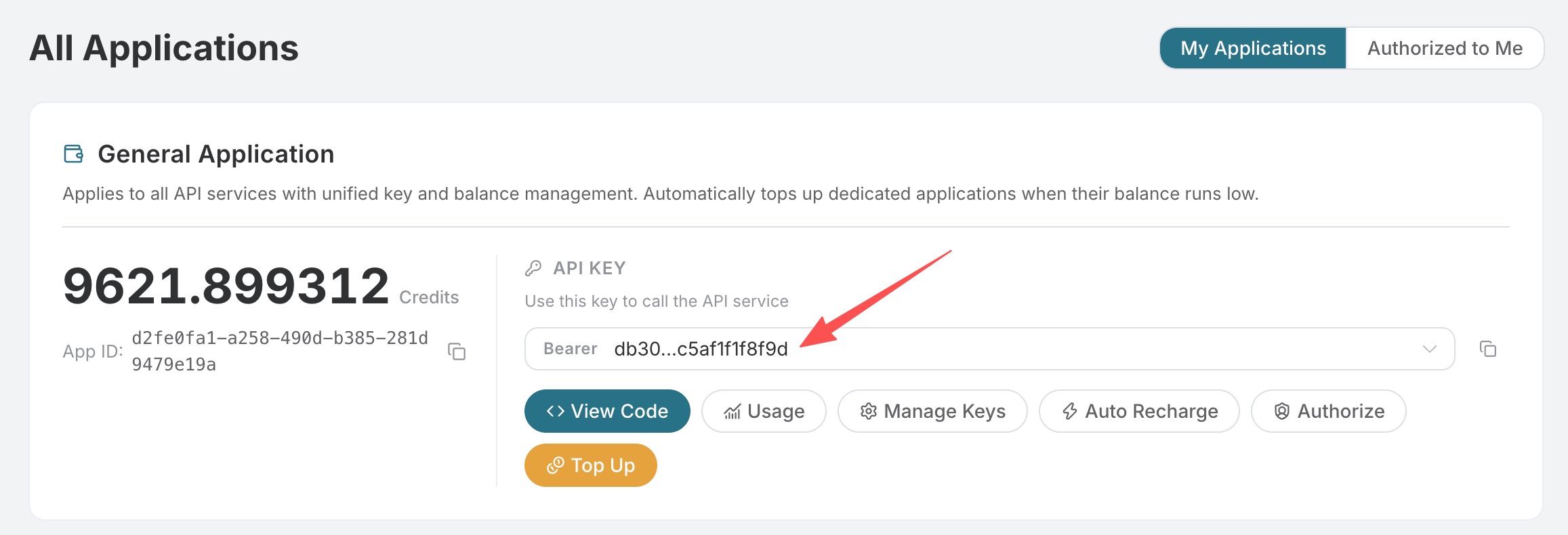 If you have not logged in or registered yet, you will be automatically redirected to the login page to register and log in, and will automatically return to the current page after completion.
One API Token can call all platform services; there is no need to apply separately for each service. Your first application will receive free credits for a free trial; when credits are insufficient, you can recharge your general balance in the Console.
If you have not logged in or registered yet, you will be automatically redirected to the login page to register and log in, and will automatically return to the current page after completion.
One API Token can call all platform services; there is no need to apply separately for each service. Your first application will receive free credits for a free trial; when credits are insufficient, you can recharge your general balance in the Console.
📘 Full documentation: Nano Banana Images API →
API Overview
- Base URL:
https://api.acedata.cloud - Endpoint:
POST /nano-banana/images - Authentication: Include
authorization: Bearer {token}in the HTTP Header - Request Headers:
accept: application/jsoncontent-type: application/json
- Actions (
action):generate: Generate images based on text promptsedit: Edit based on given images
- Models (
model) (optional):nano-banana(default): Based on Gemini 2.5 Flash Image, fast and low costnano-banana-2-lite: Based on Gemini 3.1 Flash Lite Image, supports 1K only, fast generation speednano-banana-2: Based on Gemini 3.1 Flash Image Preview, Pro-level quality + Flash speednano-banana-2.1: A new-generation efficient image model supporting 1K, 2K, and 4K image generation and editingnano-banana-pro: Based on Gemini 3 Pro Image Preview, highest qualitynano-banana:official,nano-banana-2-lite:official,nano-banana-2:official,nano-banana-pro:official: Official-channel versions of the corresponding models, with better image quality and stability, and different billing
- Asynchronous Callback: Optional; receive task completion notifications and results through
callback_url - Image Count: Optional; specify 1–4 images through
count, with a default of 1; each image is completed by an independent generation call; ordinary technical failures or provider safety rejections only affect the corresponding call, while other successfully generated images are returned as usual and billed according to the actual number of successful images
Quick Start: Generate Images (action=generate)
Minimum required parameters: action, promptWhen you only want to generate an image directly based on a prompt, set
action to generate and provide a clear prompt.
Request Example (cURL)
Request Example (Python)
Successful Response Example
Field Descriptions
success: Whether this request was successful.task_id: Task ID.trace_id: Trace ID for troubleshooting.count: The number of images requested for generation or editing, supporting 1–4, with a default of 1.datacontains only successfully generated images and is billed according to the actual number of returned images. Each generation call is required to use the provider’s native safety policy; a rejected call does not affect other successful calls, and a 403 is returned when all calls are rejected.data[]: Result list.prompt: The prompt used for generation (echoed).image_url: Direct URL of the generated image.
Note:/nano-banana/imagesonly requiresactionandpromptto generate images
Edit Images (action=edit)
When you want to edit based on existing images, set action to edit, pass in a list of image links to be edited (one or multiple images) through image_urls, and provide a prompt describing the editing target.
For example, here we provide a photo of a person and a photo of clothing, and want the person to wear this clothing. You can pass in the image links at the same time and specify action as edit. The URL can be an HTTP URL, a publicly accessible link using the https or http protocol, or a Base64-encoded image, such as data:image/png;base64,iVBORw0KGgoAAAANSUhEUgAAA+gAAAVGCAMAAAA6u2FyAAADAFBMVEXq6uwdHCEeHyMdHS....
Request Example (cURL)
Request Example (Python)
Successful Response Example
Field Description
image_urls[]: List of image URLs to be edited (must be publicly accessible). Multiple images can be provided; the service will combine these materials with thepromptto complete the editing.- Other fields are the same as the response for “Generate Image”.
Asynchronous Callback (Optional, Recommended)
Generating or editing may take some time. To avoid long connections consuming resources, it is recommended to use a Webhook callback throughcallback_url:
- Add
callback_urlto the request body, for example, your server-side Webhook address (must be publicly accessible and support POST JSON). - The API will immediately return a response containing
task_id(or containing basic results). - When the task is complete, the platform will send the full JSON to
callback_urlviaPOST. You can associate the request with the result throughtask_id.
Error Handling
When a call fails, a standard error format and trace ID will be returned. Common errors are as follows:- 400
token_mismatched: The request is invalid or there is a parameter error. - 400
api_not_implemented: The API is not implemented (please contact support). - 401
invalid_token: Authentication failed or Token is missing. - 403
forbidden: The provider’s native security policy rejected the request or generated result. This call will not return an image and will not be charged; multi-image requests may still return and charge for other successful calls. - 429
too_many_requests: Request rate limit exceeded. - 500
api_error: Server-side exception.
Error Response Example
Parameter Reference and Notes
- Required:
action,prompt - Edit-only:
image_urls(array, at least 1 item) - Optional:
model(default:nano-banana; optional:nano-banana-2-lite,nano-banana-2,nano-banana-2.1,nano-banana-pro; except fornano-banana-2.1, corresponding:officialofficial-channel versions are also available),aspect_ratio(aspect ratio, such as1:1,16:9),resolution(resolution, such as1K,2K,4K;nano-banana-2-litesupports only1K),callback_url(used for asynchronous callbacks) - Headers:
authorization: Bearer {token}must be provided;acceptis recommended to be set toapplication/json - Image Accessibility:
image_urlsmust be publicly accessible direct links (HTTP/HTTPS); HTTPS is recommended - Idempotency and Tracking: Retain
task_idandtrace_idfor troubleshooting and result association