

Application Process
To use AI ID Photo Production API, first open the Ace Data Cloud Console and copy your API Token.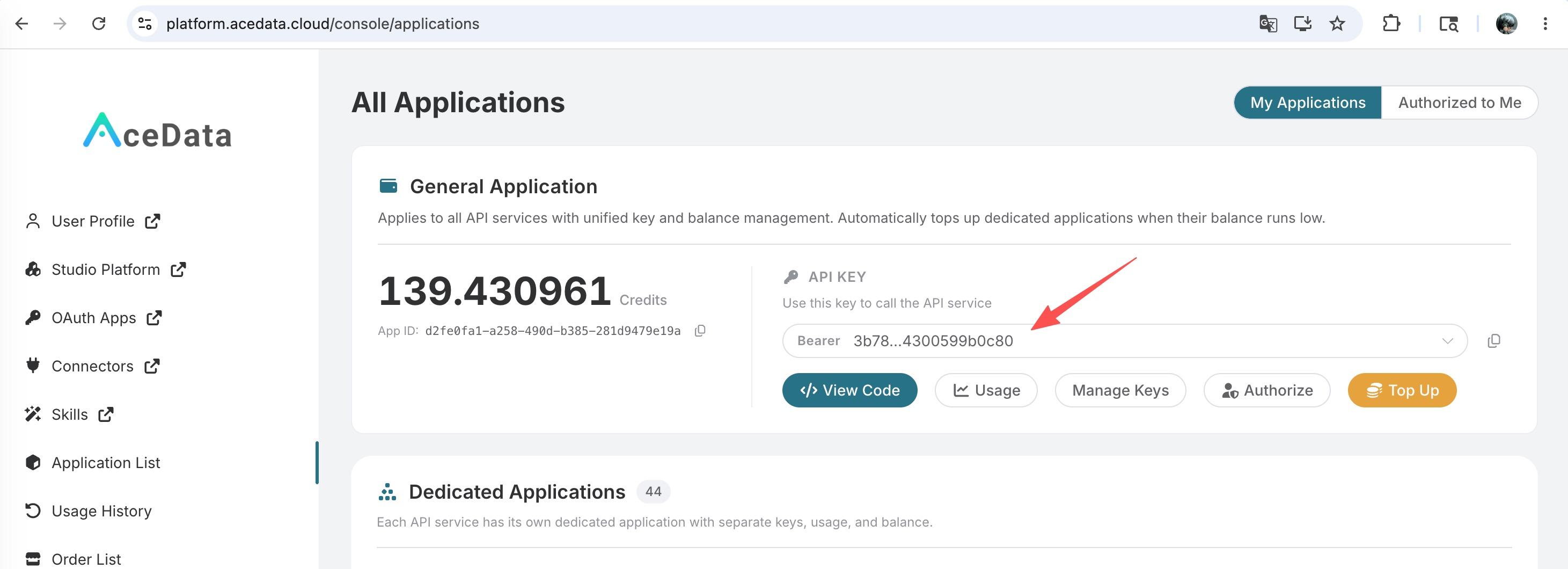 If you are not logged in, you will be redirected to sign in and brought back to this page automatically.
A single API Token works across every service on the platform — no need to subscribe per service. New accounts receive free starter credit; when it runs low you can top up your shared balance in the console.
If you are not logged in, you will be redirected to sign in and brought back to this page automatically.
A single API Token works across every service on the platform — no need to subscribe per service. New accounts receive free starter credit; when it runs low you can top up your shared balance in the console.
📘 Full documentation: AI ID Photo Production API →
Basic Usage
First, understand the basic usage method, which is to input the portrait image that needs to be processed and the preferred AI ID photo template to obtain the processed result. You first need to simply pass aimage_urls field, which is an array of links to the portrait images that need to be processed, as shown in the image:

mode, which is generally divided into two types: slow relax and fast fast. The specific content is as follows:
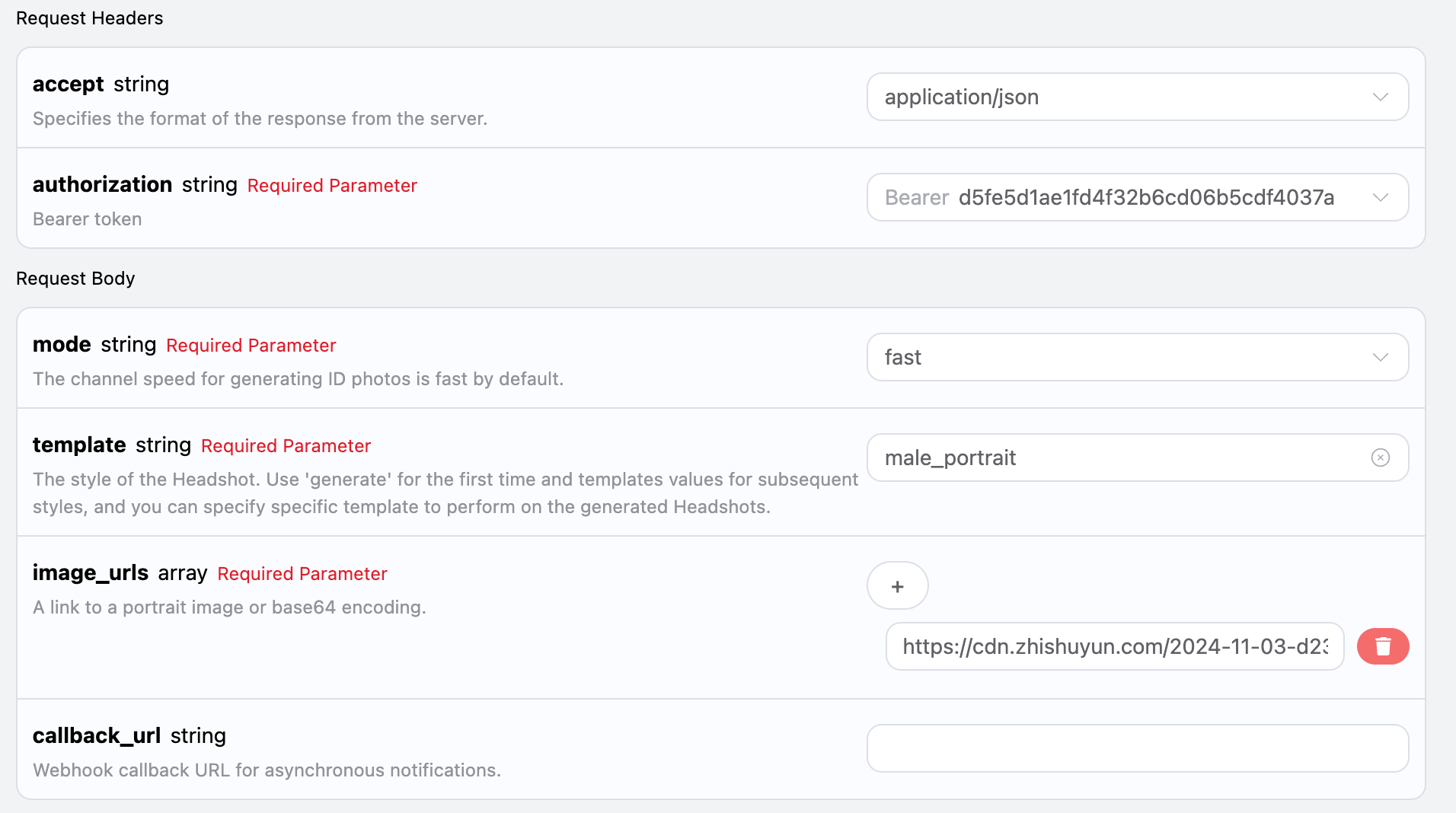
accept: The format of the response result you want to receive, here filled in asapplication/json, which means JSON format.authorization: The key to call the API, which can be directly selected after application.
mode: The channel for generating ID photos, mainly with two types: fast and relax. When using relax, it is strongly recommended to use the parametercallback_urlbelow.template: The style of the ID photo template.image_urls: The links to the ID photo portraits that need to be uploaded.callback_url: The URL to receive the callback result.
success: The status of the ID photo generation task at this time.task_id: The ID of the ID photo generation task at this time.data: The result list of the ID photo generation task at this time.id: The photo ID of the ID photo generation task at this time.image_url: The image link of the ID photo generation task at this time.template: The name of the ID photo template for the ID photo generation task at this time.
data result.
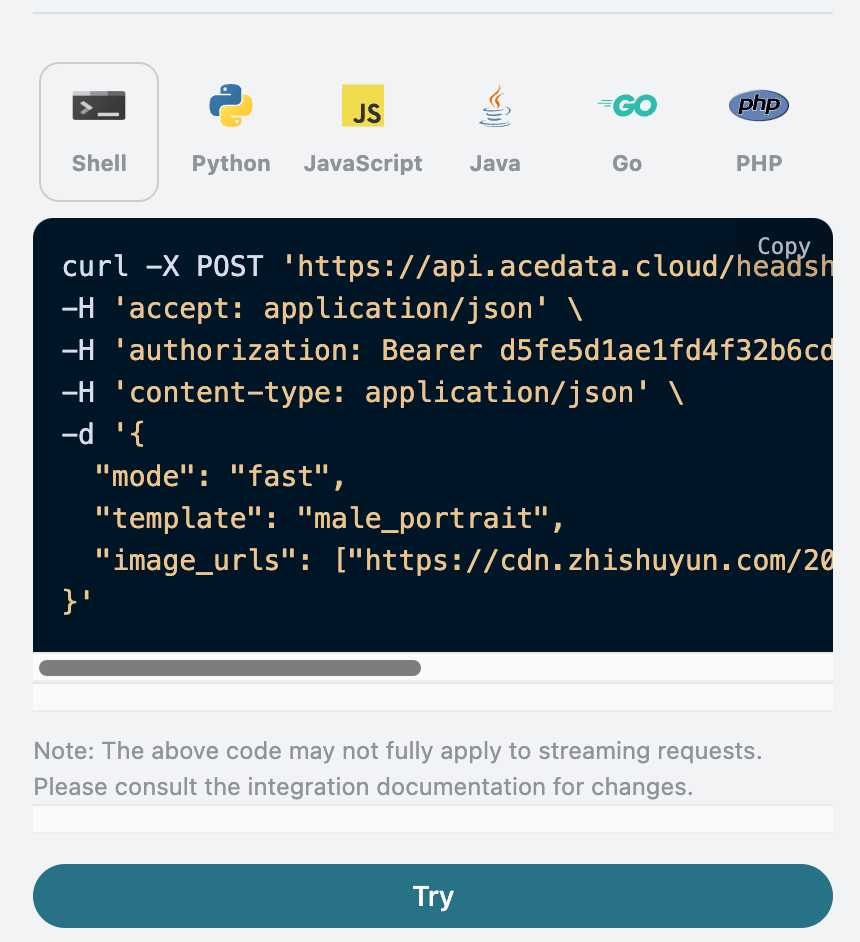
Additionally, if you want to generate the corresponding integration code, you can directly copy the generated code, for example, the CURL code is as follows:
Asynchronous Callback
Since the AI ID photo generation time is relatively long, approximately 1-2 minutes, if the API does not respond for a long time, the HTTP request will keep the connection open, leading to additional system resource consumption. Therefore, this API also provides support for asynchronous callbacks. The overall process is: when the client initiates a request, an additionalcallback_url field is specified. After the client initiates the API request, the API will immediately return a result containing a task_id field information, representing the current task ID. When the task is completed, the result of the generated ID photo will be sent to the client-specified callback_url in the form of a POST JSON, which also includes the task_id field, allowing the task result to be associated by ID.
Let’s understand how to operate specifically through an example.
First, the Webhook callback is a service that can receive HTTP requests, and developers should replace it with the URL of their own HTTP server. For convenience in demonstration, we use a public Webhook sample site https://webhook.site/, where you can open the site to get a Webhook URL, as shown in the image:
 Copy this URL, and it can be used as a Webhook. The sample here is
 https://webhook.site/00f38b26-4289-4899-83d6-0cea7308850a.
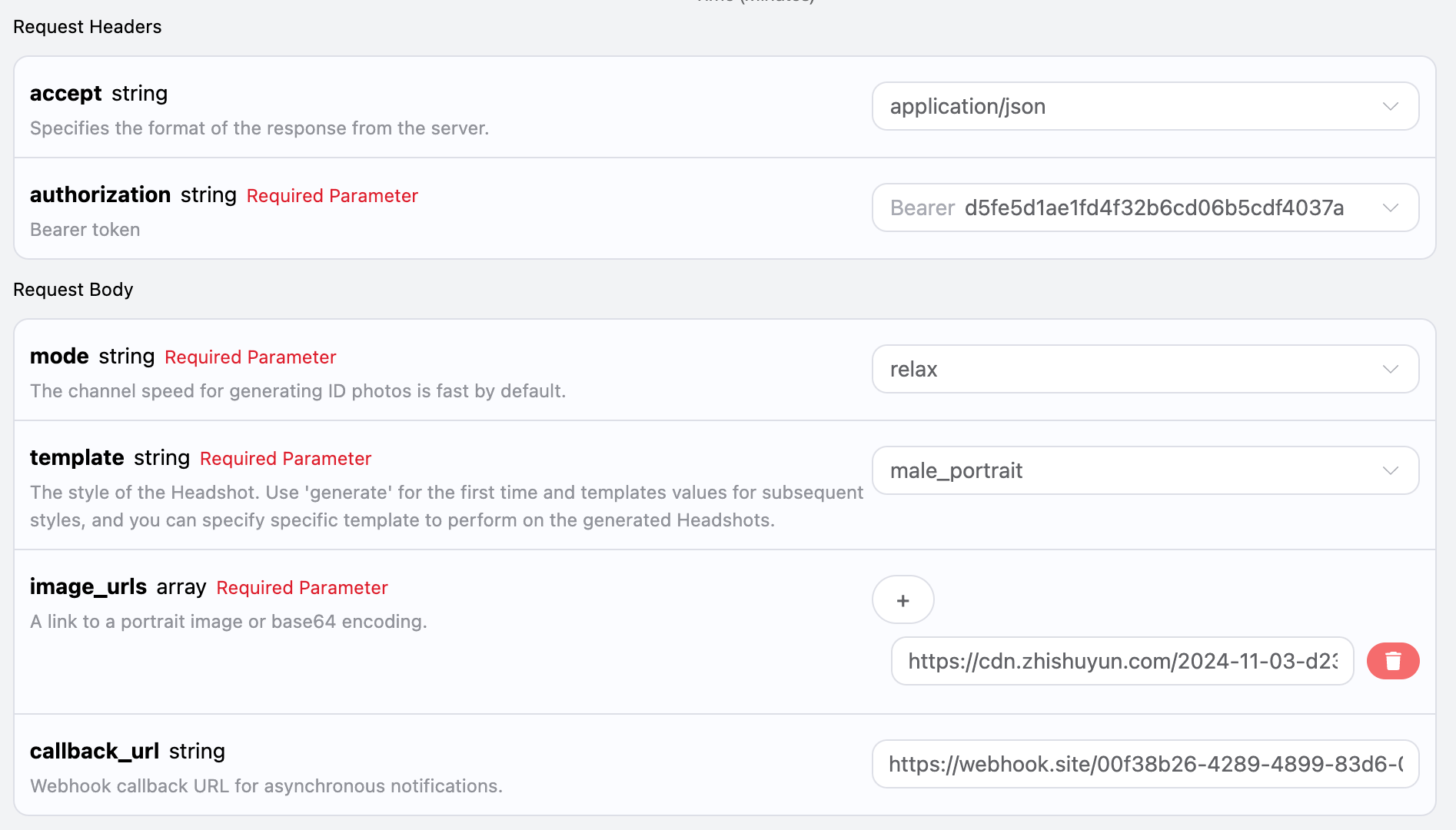
Next, we can set the callback_url field to the above Webhook URL, while filling in the portrait image link and template. This article recommends using asynchronous callbacks when the parameter mode is set to relax, as shown in the image:
https://webhook.site/00f38b26-4289-4899-83d6-0cea7308850a, as shown in the image:
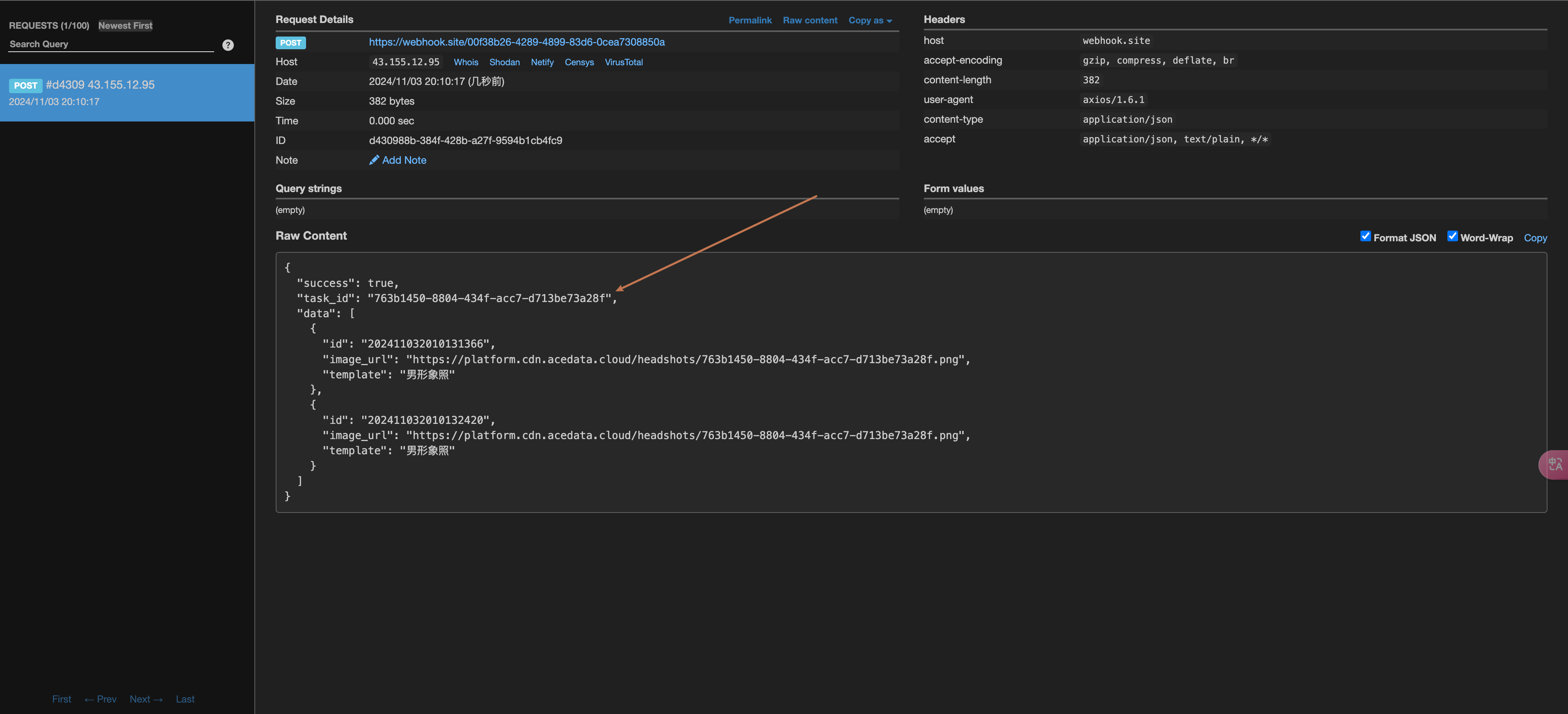 The content is as follows:
task_id field, and other fields are similar to the above text. This field can be used to associate tasks.
Error Handling
When calling the API, if an error occurs, the API will return the corresponding error code and message. For example:400 token_mismatched: Bad request, possibly due to missing or invalid parameters.400 api_not_implemented: Bad request, possibly due to missing or invalid parameters.401 invalid_token: Unauthorized, invalid or missing authorization token.429 too_many_requests: Too many requests, you have exceeded the rate limit.500 api_error: Internal server error, something went wrong on the server.